
Storm Damage · 5 min read ·
How to Tell If Your Roof Has Hail Damage: The Test Square and Your Storm
A test square is one way adjusters count hail hits. Here is what it is, what it is not, and how to match your roof to a real storm.
01
The short answer
To tell if your roof has hail damage, start from the ground and do not climb. Look for granules in the gutters and dents on metal parts like vents. Then check that a real storm hit your area on that date in NOAA's records. A documented inspection, often using a test square, confirms what is on the roof. This is part of our storm damage guide.
02
What is a hail test square?
A test square is a marked area on one roof slope where hail hits are counted. I call it the 10x10 square. Many adjusters use one, often 10 by 10 feet. The idea is simple: count what is in the box, and the count stands in for the slope.
It is not a law. It is not a promise about your roof. Carriers and policies differ, so your insurer and your policy decide how a count is used. Ask your insurer and read your policy. We document what is actually there, with photos.
Want a pro to look at your roof?
Free. No obligation. Bailey calls or texts you back.

03
What a test square does not tell you
It does not tell you whether the hail came from a storm that hit your address. It does not tell you how old the roof is. It does not tell you whether your policy covers hail, or how it settles roof damage. The NC Department of Insurance notes that some homeowners policies exclude windstorm or hail (NCDOI). Read your policy and ask your agent.
04
How do I tell if my roof has hail damage?
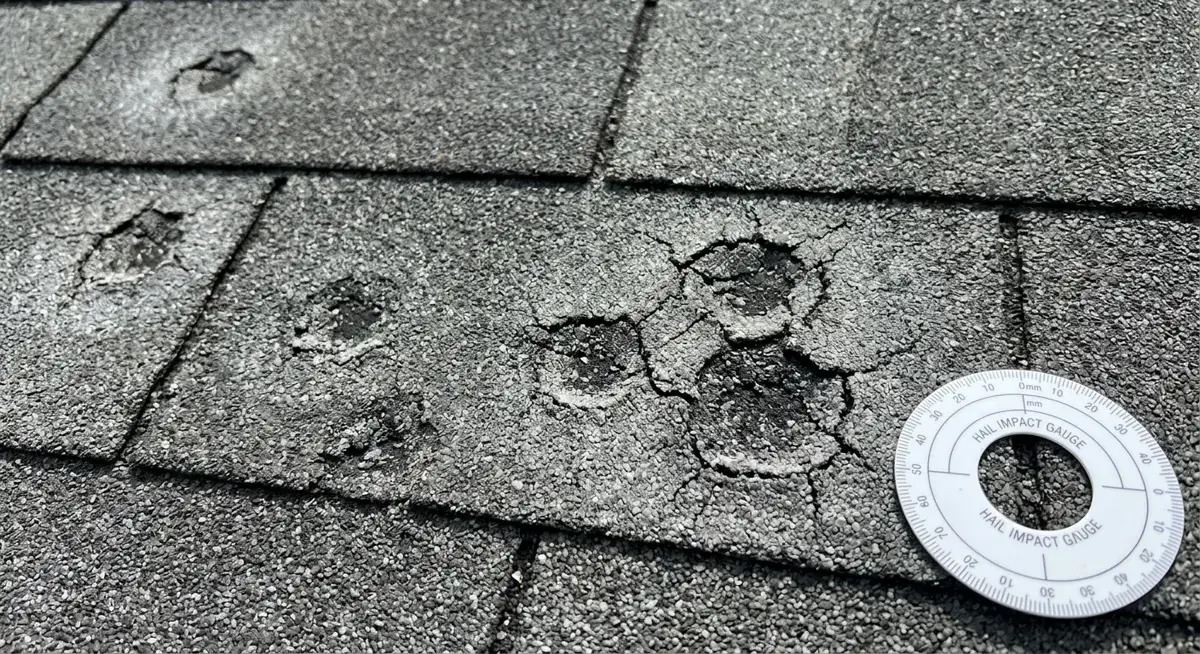
Start from the ground, and do not climb. Look in the gutters and at the base of the downspouts for granules. The first thing I check on a roof is the gutters. If I see a bunch of granules, that tells me the roof is old and really susceptible to storm damage. Look at metal parts you can see, like vents, for dents. I put chalk on the metal, and that helps me find the spots where something hit it (walkthrough here). Then get the roof documented. From the driveway, hail hits are easy to miss. For what hail hits look like up close, read how to spot hail damage on your roof.
05
Why do the storm date, wind and hail size have to line up?
Because a roof mark means more when a real storm explains it. After I look at the roof, I check the storm information: the date, the wind speed and how big the hail was. All of those things need to be in line. If the hits on the roof say one thing and the storm record says another, that is worth knowing before you decide anything.
06
How do I look up the storm at my address?
Use NOAA's public records. The NOAA Storm Events Database lets you search by state, county and date range. Pick North Carolina, then Wake, Durham or Orange County, and the month of your storm. Each entry lists the date, the type of event and, for hail, the reported size.
Two cautions. These are reports made to the National Weather Service. A storm can damage a roof even when nobody on your street reported it. And a report in your county may be miles from your house. We keep a dated list for our three counties in the storm log on our storm damage page. For example, it includes five hail reports from Wake County on July 8, 2026, and 1.75-inch hail near Apex on April 14, 2023. You can also check the National Weather Service office in Raleigh for local storm information.
07
What does hail size do to a roof?
There is no single size that damages every roof. The National Weather Service calls a storm severe when it can produce hail of one inch or larger, and says hail that size can damage roofs, cars and plants (NWS). The Storm Prediction Center compares sizes to everyday objects: a penny is 0.75 inch, a quarter is 1 inch, and a golf ball is 1.75 inches (SPC hail size chart). The Insurance Institute for Business and Home Safety studies how roof age changes how a roof holds up (IBHS hail research).
08
What should I do after a hail storm?
The NC Department of Insurance advises contacting your insurance company first after storm damage (NCDOI). Write down the date of the storm. Take photos from the ground. Read your policy. It sets the deadline for reporting damage, and most ask for prompt notice. Your agent can answer coverage questions. Your insurer decides coverage under your policy. We document the damage with photos and a written report you keep. If you file, we can be on site when the adjuster inspects, to point out what we documented. For how coverage works in North Carolina, read does homeowners insurance cover roof replacement.
09
What to do next
If a storm came through, request a free inspection or call (984) 217-6631. We document what is actually on the roof, and you keep the report.
Related services
Check us yourself, on Google and the BBB
Want a pro to look at your roof?
A free inspection comes with a photo report you can keep.
Free. No obligation. Bailey calls or texts you back.